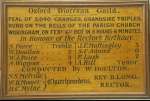
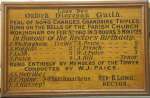
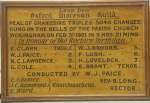
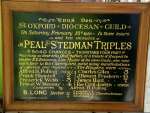
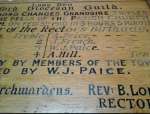
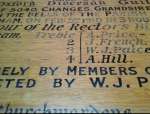
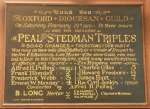
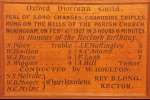
The peal boards
History
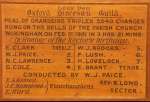
The first recorded true peal was in 1715 at St Peter Mancroft, Norwich , recorded on a decorative pealboard. Over the centuries pealboards, some very ornate, have been hung in many tower to record notable performances. The first peal at All Saints was rung in 1903, shortly after the augmention to eight. It is in the peal book, but there is no pealboard for it and it wasn't rung by a local band.
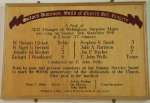
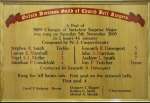
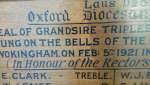
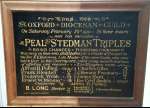
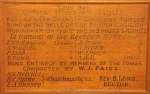
Nine peals were rung for the Rector's birthday between 1907 and 1932, and those in 1907, 1910 and 1921 have pealboards. The peal in 1910 on the day of Rev FE Robinson's funeral is recorded on a guilded pealboard
The two modern pealboards (one each by Linda Moores and Maggie Willans) record the 1999 peal for the church's 800th anniversary and the first peal on the bells after the 2004 restoration .
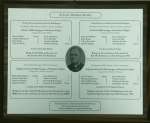
A smaller (A4) composit pealboard and iengraved on metal alloy was ommissioned in 2010 to record four performances in memory of Rev FE Robinson : a peal for the 80th anniversary of his death, a quarter peal for the 100th anniversary of when he believed he rang his 1000th peal, and a peal and a quarter peal for the centenary of his death..
Pictures
To see a larger image click on a thumbnail.
Restoration
Following concerns about the condition of one of the early 20th century pealboards they were assessed by a professional restorer in 2015. The main concern was the lettering on the 1910 'Rector's birthday peal' board, which was badly degraded, with much of the paint having chipped off. The guilding lettering on the pealboard for FE Robinson's funeral was also cracked. In addition, all the boards had a layer of accumulated grime. The inspection confirmed that the boards could be restored to near original condition, and recommended that all four boards should be restored since otherwise the non-restored ones would look drab and dirty alongside the restored one.
The restorer declared the boards stable, and so restoration was delayed until after completion of the much bigger project to install a glass screen in the gallery arch , which was completed in 2016.
In the summer of 2017 the boards were restored by MT Molner Convervation of Tilehurst . All the boards were cleaned of superficial dust and then had the greasy top deposits removed with white spirit. they were then thoroughly cleaned with a special non-acid conservation liquid soap.
The damage to the black lettering was restored using an oil based polyurethane laqueur, which has the correct 'body' to replicate the original work.
The gold lettering was restored using an acrylic liquid metal gold paint ('Classic Gold' shade) which doesn't tarnish.The lettering was completely over painted, since just covering the separations didn't give a satisfactory result.
The boards were varnished with a water based Ronseal varnish (also applied to the backs)and given a sprayed Shellac coating to protect the lettering.
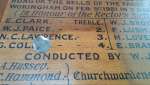
Pictures of various intermediate stages in the work are below. Click on a thumbnail to see a larger image.
Before restoration
Updated