The writing on the wall – 5
This is the fourth snippet from my work looking at graffiti in the church.
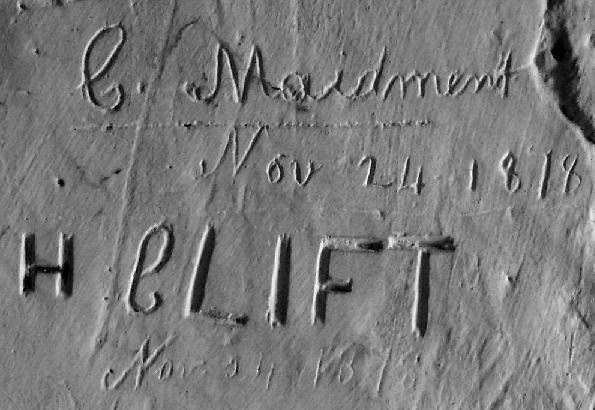 The easily carvable surfaces in the clock room are densely covered with graffiti, so finding two names close together isn’t surprising, especially when the same date appears under both names. Maybe two friends were there on the same occasion and both wanted to record their names. Or maybe one of them saw the other’s name some time later and decided to follow suit.
In such situations one might expect the writing style to be different, unless they were together and one of them was either more skilful or a more dominant and so wrote both of them. But neither of those scenarios can explain what we see here.
The name ‘C. Maidment’, the ‘C’ of ‘H...CLIFT’ and the dates beneath them – both ‘Nov 24 1818’ – are written in a flowing script, which suggests they were all carved by the same person. But the remaining letters of ‘H...CLIFT’ are cut much more deeply as block capitals, with the ‘L’ slightly misaliagned and the ‘H’ slightly smaller. That suggests someone with less confidence but it doesn’t explain why someone else wrote one of the letters.
Who were they? There was a Charles Maidment born in Wokingham in 1819. Perhaps his father was also named Charles, and perhaps he made the inscription. The family remained in Wokingham, and Timothy Maidment, born in 1866, was a ringer at All Saints in 1884. We don’t know when he started, and we don’t know whether Charles also rang because our records only began in 1880.
Clift is more elusive. There was a Henry Clift who died in Wokingham in 1883. If he was in his 80s then he would have been a teenager in 1818. Maybe he carved the name. We don’t know,
John Harrison (xxx 2026)


